Cite this as: Forster, M. and Parker Wooding, J. 2026 'Work Digital, Think Archive, Create Access: Exploring The Legacy Of The Dig Digital Project', Internet Archaeology 72. https://doi.org/10.11141/ia.72.6
Memory, like history, is rooted in archives. Without archives, memory falters, knowledge of accomplishments fades, pride in a shared past dissipates. Archives counter these losses. Archives contain the evidence of what went before. (Schwartz and Cook 2002)
The question of how to manage digital archives in archaeology has been a topic of interest for years. Digital technologies have transformed the way archaeologists work, providing innovative research tools, improving site investigations and giving new life to knowledge about the past. As with all parts of an archaeological archive, digital data contributes to the long-term preservation of sites by providing key information that can be accessed by researchers and the public alike. How that information can be used in the future is an important consideration and, as innovative technologies become the norm, we must be sure that our archive processes adapt to incorporate new methods, tools and data.
This article discusses the development, implementation and legacy of Dig Digital, a professional Toolkit that provides guidance and resources for practitioners that embeds and promotes FAIR (Findable, Accessible, Interoperable and Reusable) principles (see Wilkinson et al. 2016) into the management of archaeological project data.
The archaeological archive comprises information that will facilitate reanalysis and reinterpretation of a site or project in the light of new data, new research questions, new techniques and new technology. Making data available for access is not just a requirement in archaeology but is increasingly applied across all research-based sectors with the development and implementation of FAIR data principles (see Wilkinson et al. 2016). The reasons for this are logical, but worth reiterating:
A truly 'public' archaeology should place much greater emphasis on the use of archaeology in the present by a wider audience ... As far as archaeological archives are concerned, this must involve…the development of coherent strategies for public involvement in archaeology as a whole. (Merriman and Swain 1999)
The accessibility of archives for research and public interest is a key consideration when promoting the value of the material we keep in museum stores and repositories. Archaeologists are aware of the importance of retaining archives and responding to the destructive nature of investigation by making the site records and finds accessible to all. However, extending this perspective to all records must include digital data — whether born digital or digitised — and our awareness of the importance of archives needs to be applied to all elements equally from the planning stages of a project.
The importance of archaeological archives is highlighted in several Chartered Institute for Archaeologists (CIfA) standards and guidance documents, but the most relevant for archaeological data archives is the Standard and guidance for the creation, compilation, transfer and deposition of archaeological archives (CIfA 2014, updated 2020). This provides a benchmark for the archaeological community for all elements of the archaeological archive.
The CIfA Standard for archaeological archives (2020) states that:
All archaeological projects that include the recovery or generation of data and/or archaeological materials (finds) will result in a stable, ordered, accessible archive. All archaeologists are responsible for ensuring that the archive is created and compiled to recognised standards, using consistent methods, and is not subject to unnecessary risk of damage or loss. It is the responsibility of all curators of archaeological archives to ensure that archives are stored to recognised standards for long-term preservation and made accessible for consultation.
Consultation at the start of the Dig Digital project highlighted that, whilst there was a wide implementation of the standard to physical archive materials, the same could not be consistently demonstrated for digital archives. The level of digital innovation, new technologies and methods that record and collect data since the 1990s has resulted in enormous amounts of different types of data being produced. Yet very little was being systematically treated as archive products (Edwards 2012). It became clear to the Archaeological Archive Forum (AAF) members, including CIfA, that additional guidance and resources were needed to support practitioners to meet the professional Standard.
In 2018, DigVentures and project partners, including the CIfA, were commissioned to undertake a project exploring the development of a standard for digital archives (Figure 1). That idea developed into the 'Dig Digital Toolkit' but was borne out of discussions that first took place several years prior. A report for the Society for Museum Archaeology highlighted that the issue of data in archives was not being addressed, estimating that 1.25 million digital files that could not be deposited with a museum were being held in contracting organisations (Edwards 2012). The AAF established a working group focusing on digital archives in 2014 ,with a joint statement from members calling for archaeologists and heritage practitioners working across archaeological projects to support implementation of good practice for digital data. The initial idea for Dig Digital started to take root. Then, in response to the Mendoza Review in 2017 (Mendoza 2017), Historic England recommended that long-term storage and preservation of digital archive material should be undertaken by a specialist repository, rather than museums (Trow 2018). This provided the mandate needed to move forward and develop a dedicated project focused on the management and archiving of digital data generated from archaeological investigations: Dig Digital.

Despite comprehensive adoption of new technologies within projects, the application of general archive standards to digital data trailed significantly behind an exponential growth of digital products. Until recently, in the UK, most project briefs issued as part of development-led archaeology did not specify any requirements for digital archive material. ALGAO England's Planning for Archives (Donnelly-Symes 2019) reported that 23.5 per cent (12/51) of responding services had no requirements for digital archive and revealed confusion over what constituted a digital archive.
This lack of clarity was recorded in the early stages of the Dig Digital project, with the 2019 Starter for Ten consultation survey suggesting that only 7 per cent (10/139) of project team respondents felt requirements for digital data were clear. An overwhelming 96 per cent (26/27) of museum practitioners indicated a need for more guidance, and all respondents felt that general everyday guidance that helped to embed a 'whole organisation' awareness and approach would be welcome. The Dig Digital survey results asked for clear signposting of how CIfA standards and guidance relate to digital data, as well as a need for guidance to help meet those standards. Multiple stages of consultation and review have followed, helping to refine the project mission and better understand the impact of the project throughout delivery.
The process of excavation is destructive, and no archaeological interpretations are sustainable unless they can be backed up with the evidence of field record and post excavation analysis. Such records and analysis should be available for re-examination and re-interpretation. (Swain 2011)
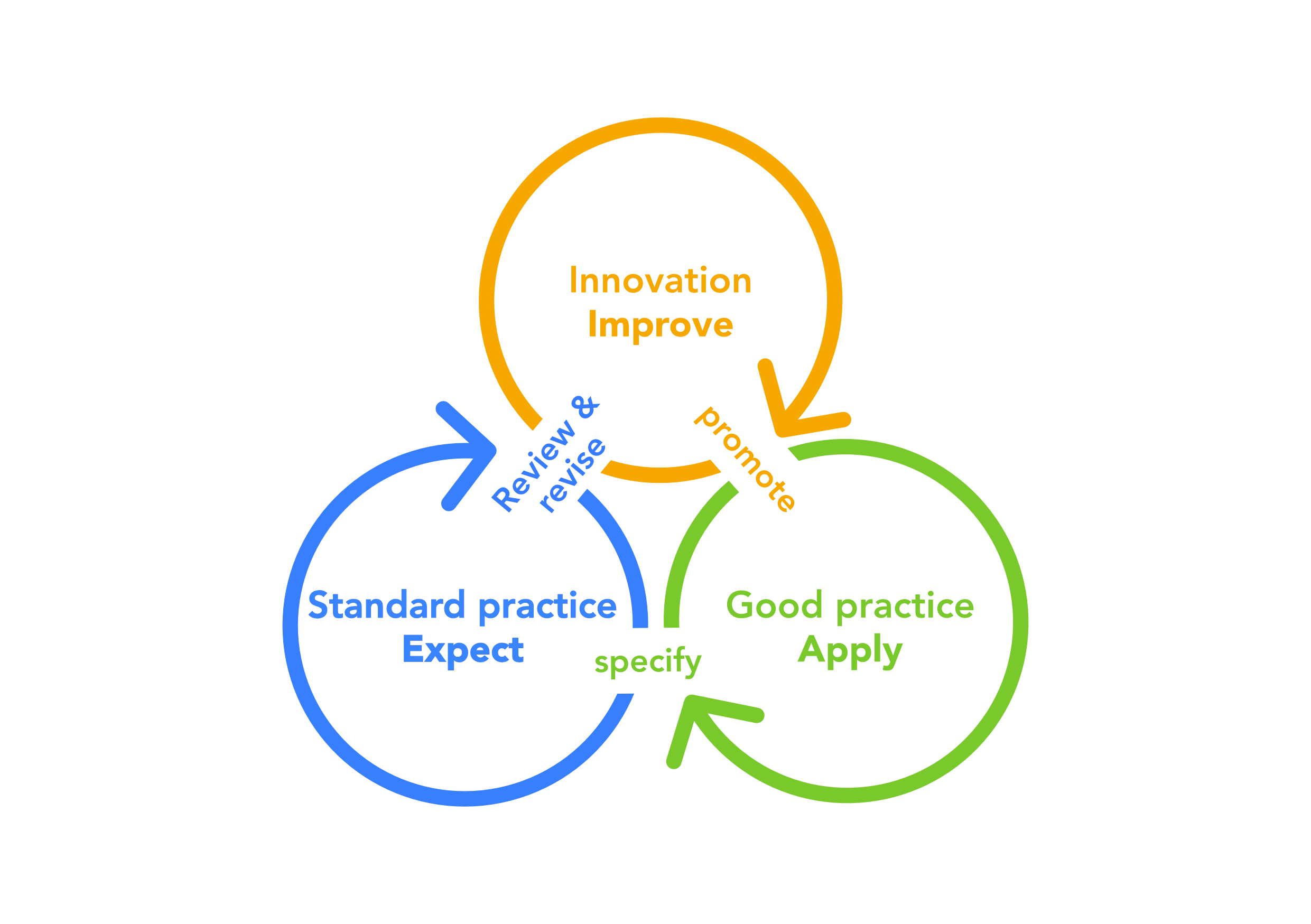
An early product of the Dig Digital programme was the creation of a guidance document linking professional practice in archaeology (as supported by CIfA's standards and guidance) to key frameworks that considered digital research data, namely the FAIR Guiding Principles (Wilkinson et al. 2016). This meant that the existing CIfA guidance was aligned to FAIR principles, a move supported by an update to CIfA's archive-specific guidance to make clear how and when digital archives should be considered in the archaeological project. This responds to the interrelationship between innovation, good practice and standard expectations — allowing for new ways of working within a structure of accepted quality benchmarks as new tools and workflows appear in archaeological projects (Figure 2).
As a result, the Work Digital, Think Archive, Create Access [PDF] guidance document (Forster et al. 2019) defines how CIfA standards relate to digital materials throughout a project. This includes clarification of what should be expected at each project stage and practical advice on how to achieve those standards. A major product of the project was the development of a template Data Management Plan (DMP) that, in conjunction with a Selection Strategy, becomes a living and iterative Archiving Strategy included within the project design (sometimes referred to as the written scheme of investigation, method statement or programme of works) and subsequent project stage documentation — see CIfA Universal guidance for archaeological excavation 2023, 2.12 (l) (CIfA 2023).
The DMP approach is fundamental to good practice when working with digital data and sets up any project to deliver a FAIR data archive successfully. The Dig Digital DMP is a downloadable template tailored to archaeology and supported by a checklist version including advice and example text, both based on an example from the Digital Curation Centre. The approach complemented existing CIfA resources focused on Selection, namely the Toolkit for Selecting Archaeological Archives. With fundamental guidance and key supporting tools taking shape, the next phase of the programme focused on accessibility and use.
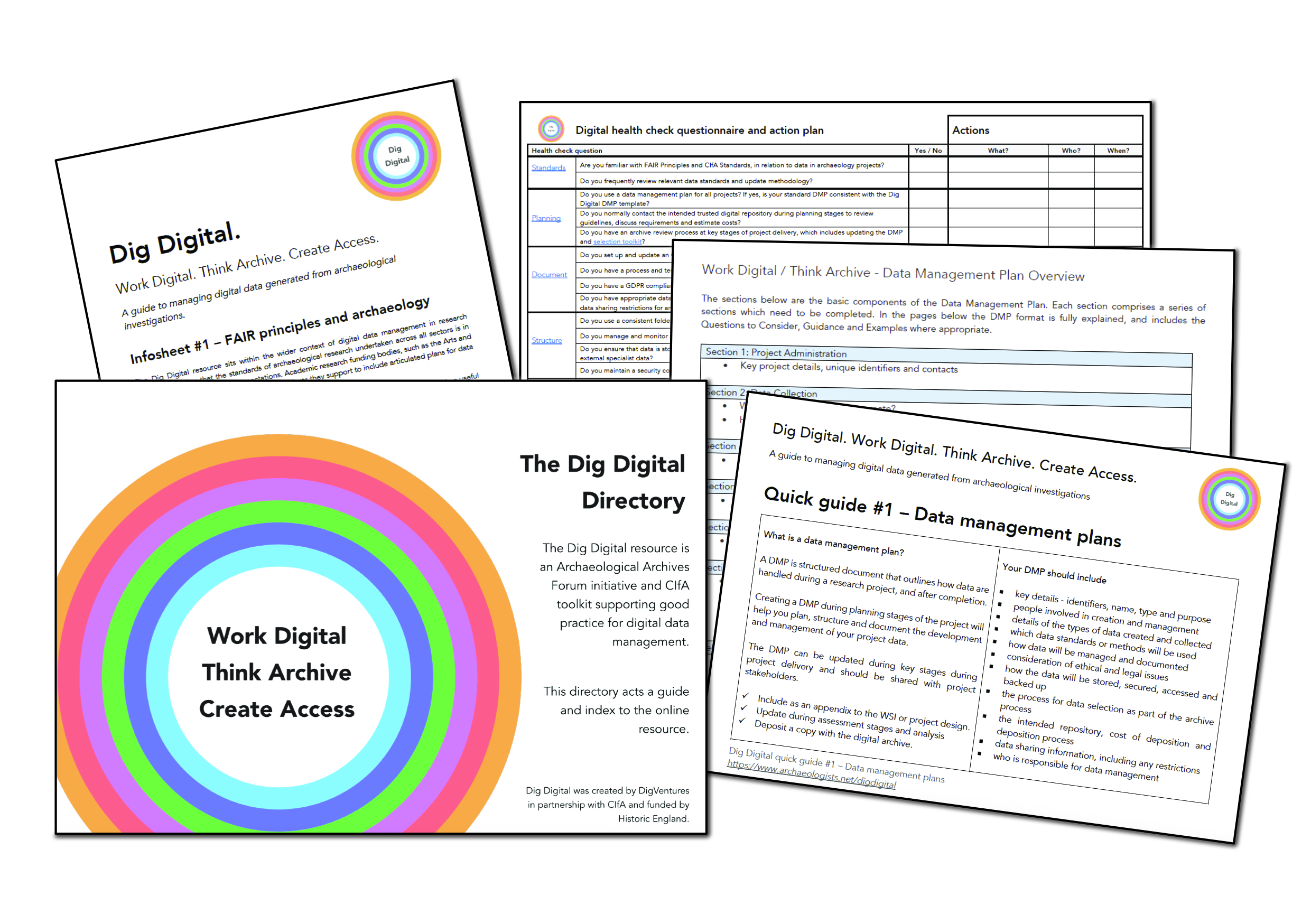
The consultation survey feedback led to an early recognition that practitioners were aware of the large amount of 'how to do digital data' guides available, but found much of it to be dense, overly technical and difficult for everyday users to relate to project workflows. The Dig Digital project's first main output — the Work Digital, Think Archive, Create Access [PDF] guidance document (Forster et al. 2019) — was a necessary step, but not particularly user-friendly. Phase 2 of the project focused on the development of a web-based Toolkit to house the Dig Digital guidance alongside newly developed resources. The resulting portfolio incorporates info sheets, quick guides and tools that support implementation, combining guidance with resources able to be tailored to organisational workflows or individual projects (Figure 3). This includes a Digital Health Check and Action Plan that creates a roadmap for implementation within an organisation or project team, signposting specific needs and actions. A Dig Digital Directory provides an interactive PDF document that can be used to easily locate resources within the toolkit, whilst providing a diagram summarising each section of the Toolkit and the tools available.
The resources include:
Archives are both our evidence and our informants, simultaneously both a primary and secondary source. Brushing against their grain opens up possibilities for alternate readings of the past and of alternate practices of knowledge generation in the future. (Baird and McFayden 2014)
In the final project stage, delivered in 2024, additional resources were created to further support implementation, raise awareness and provide training opportunities. These included:
To support the implementation of sustainable and lasting change in practice requires a collaborative approach (see Figure 1). Working with oversight from the AAF meant the project had a far greater reach across the historic environment sector. Developing and circulating a Joint Statement from all member bodies that endorsed the Toolkit provided an impactful moment for the adoption of Dig Digital and circulated a simple, common message of support. This was, in many ways, underpinned by the FAIR Guiding Principles (Wilkinson et al. 2016), which provided a good practice framework for digital data in research of any discipline demonstrating alignment with other sector approaches. It is also worth noting the vital role of the project funder, Historic England, who not only provided financial and expert advisory support to the project, but who worked collaboratively with the project team to enable a long-term, adaptive and iterative project approach.
Importantly, implementation of the guidance is supported through the project partner CIfA, that, as a professional institute, provides the ethical framework, sector reach, influence and enforcement of standards. With regards to the latter, CIfA's code of conduct and professional standards are binding on CIfA accredited members, and Registered Organisations, with the latter also required to provide evidence of, and discuss, approaches to archive management as part of routine inspections. This means that, as well as having levers of good practice baked into standards (such as the use of an Archiving Strategy combining a DMP and Selection Plan), consultation with the accreditation team signposts markers of good practice — such as the use of a DMP as a live document or consistent approach to digital data organisation — which can be investigated as part of in-person benchmarking and inspection processes.
In terms of reach and influence, the percentage of the UK archaeological workforce working in accordance with CIfA's code of conduct, professional standards and guidance (including toolkits like Dig Digital) is close to 70% (at least) of the profession (Figure 4). The State of the Archaeological Market report for 2023/2024 (Aitchison and Rocks-Macqueen 2025) indicates that, at the end of March 2024, the archaeological profession in the UK numbered 6766 overall. Of these, 4918 practitioners worked within developer-led archaeology. At the time of writing, there are 4138 CIfA members (with 3136 of those accredited), equating to 46% of the UK archaeology profession, and 81 CIfA Registered Organisations employing over 3500 members of staff (including both CIfA-accredited and non-accredited archaeologists).

This demonstrates the importance and value of developing resources that are fully integrated with existing frameworks, or that are endorsed or co-designed with professional bodies and organisations that are able to support and facilitate sustainable change. The Dig Digital Toolkit combines resources and training with enforceable requirements, which includes specific documents and processes visible within standard project documents such as project designs. Supported by communication of this via CIfA's network of members and beyond, there is now a much clearer pathway towards implementation for archaeologists working in the UK. But is practice changing as a result?
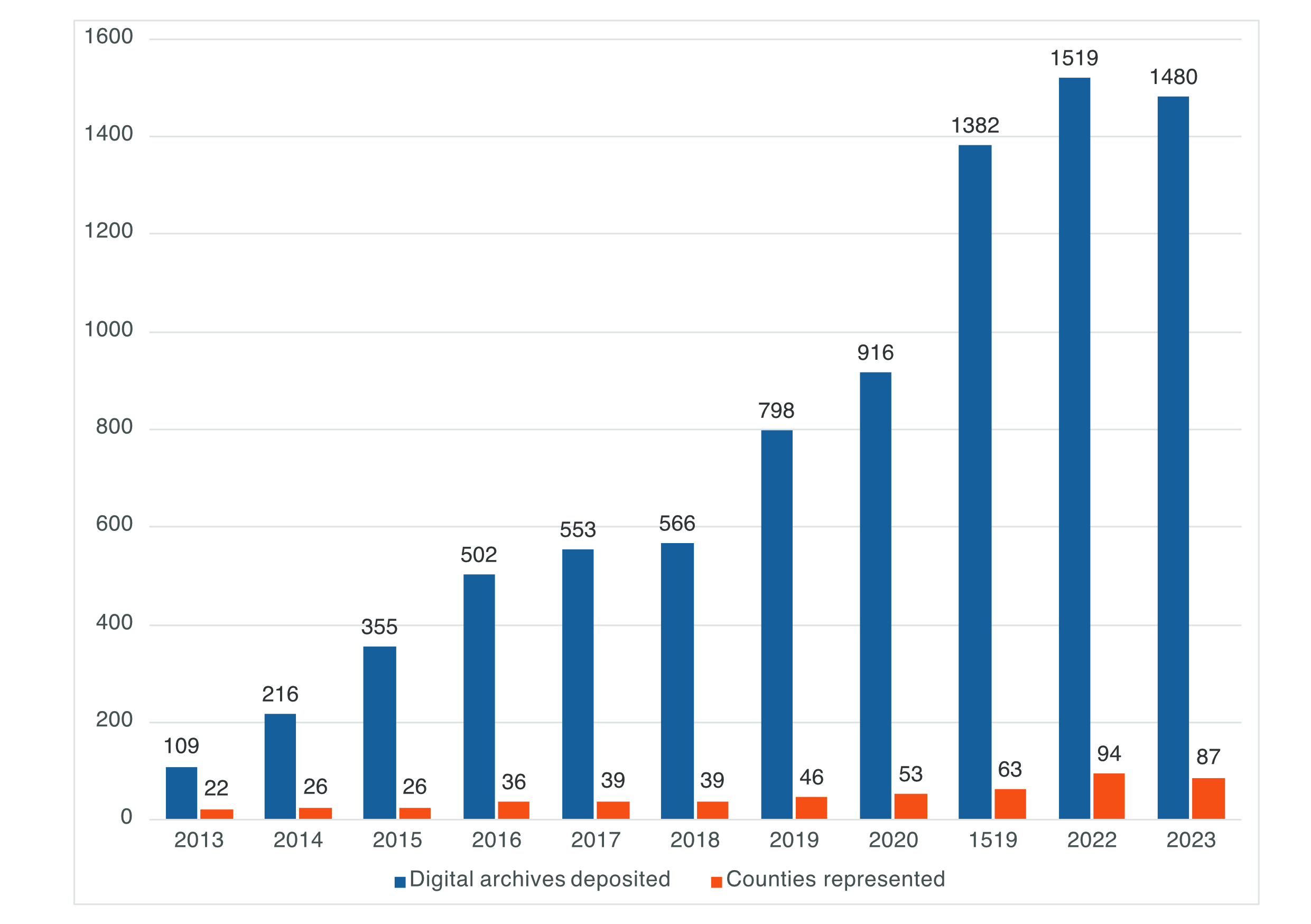
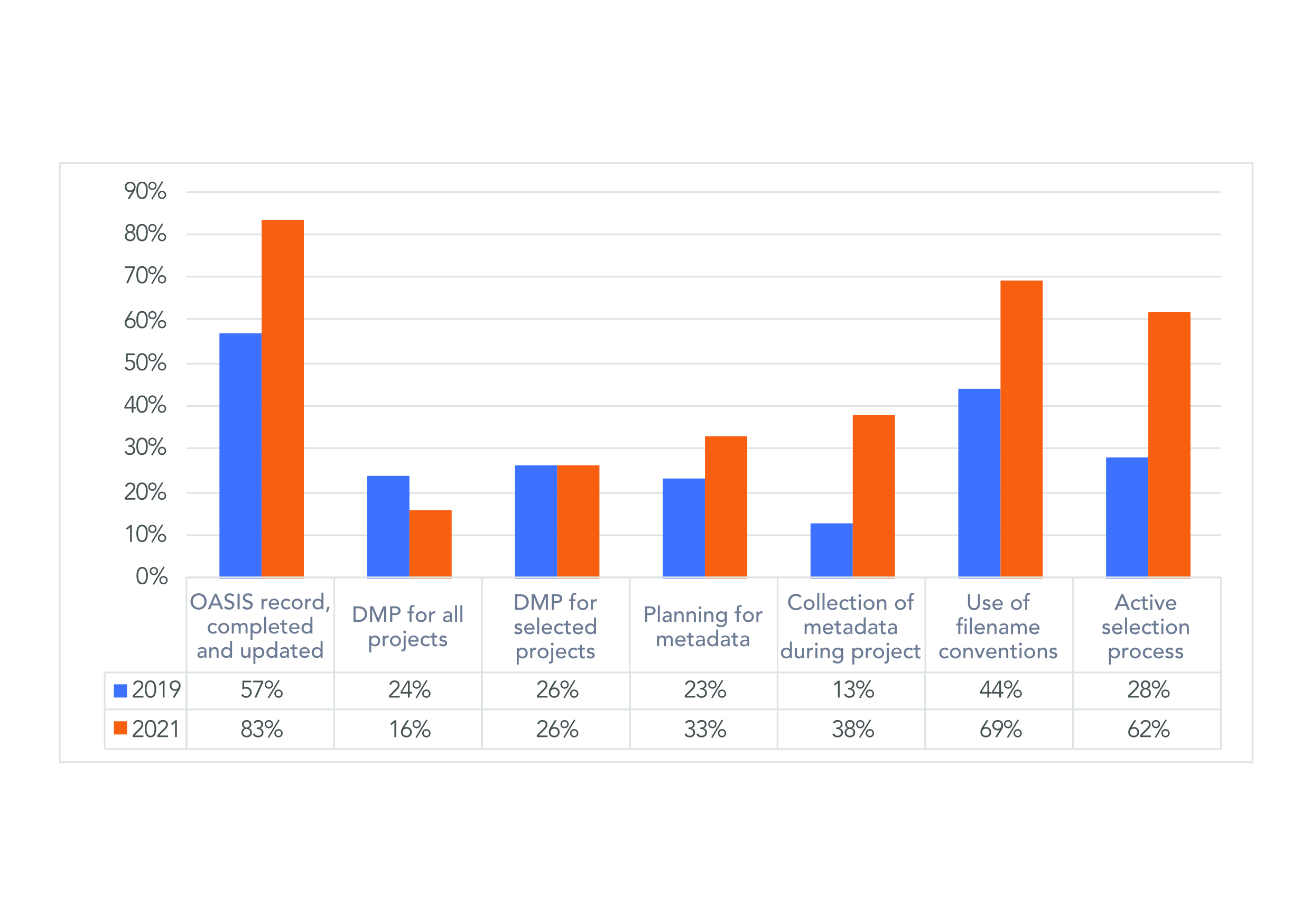
The UK-based digital repository Archaeology Data Service (ADS) has seen an increase in depositions over the last decade, a testament to the joined-up approach delivered across the archaeology and museums sector. Since 2013, there has been a steady increase in digital archive deposition, with the number of depositions increasing from 109 in 2013 to 1480 in 2023, with significant jumps in 2019 and again in 2021 (Figure 5). Importantly, this increase is not just visible in numbers of archives deposited, but also in counties represented, rising from 22 in 2013 to the highest number of 94 in 2022 (in 2023 the number was 87). Increased awareness of digital archive requirements and a change in CIfA's standard and guidance is now reflected in many of the project briefs and project designs approved at county level — a shift that has been reported through Dig Digital consultation surveys and feedback from CIfA Registered Organisations. Follow-up surveys within the Dig Digital project in 2021 indicated that practitioners felt more confident around requirements, leading to increased planning for and implementation of processes that support digital data management. These include increased use of filename conventions (from 44% in 2019 to 69% in 2021), active selection of data for archives (28% to 61%) and creation of metadata during the project (from 13% to 38%) (Figure 6). Only one area showed a downward trend — the question of DMP use in all projects. The reason for this can only be guessed at but perhaps an increased understanding means a more accurate picture was recorded.
Archaeological archives are amongst the most used museum collections. They are important evidence for communities' sense of place, provide a unique record, underpin leading-edge research and provide robust material for learning and outreach. (Fernie et al. 2017)
A decade on from its initial inception, the legacy of the Dig Digital project is yet to be fully realised, but it has been successful in supporting change and embedding new practice. The Dig Digital approach promotes the view that it is the responsibility of all archaeologists, and not just those responsible for archive deposition, to help create good archives (Figure 7). Archives created from archaeological research of all types should be Findable, Accessible, Interoperable and Reusable (FAIR), available to use by anyone well into the future. The Dig Digital resource promotes the importance of the whole project team in embedding data-friendly practices within a project or organisation. It is built upon making changes within workflows and decision-making from the beginning of a project, continuously building an ordered, stable and accessible archive through project delivery, not at project closure stages.
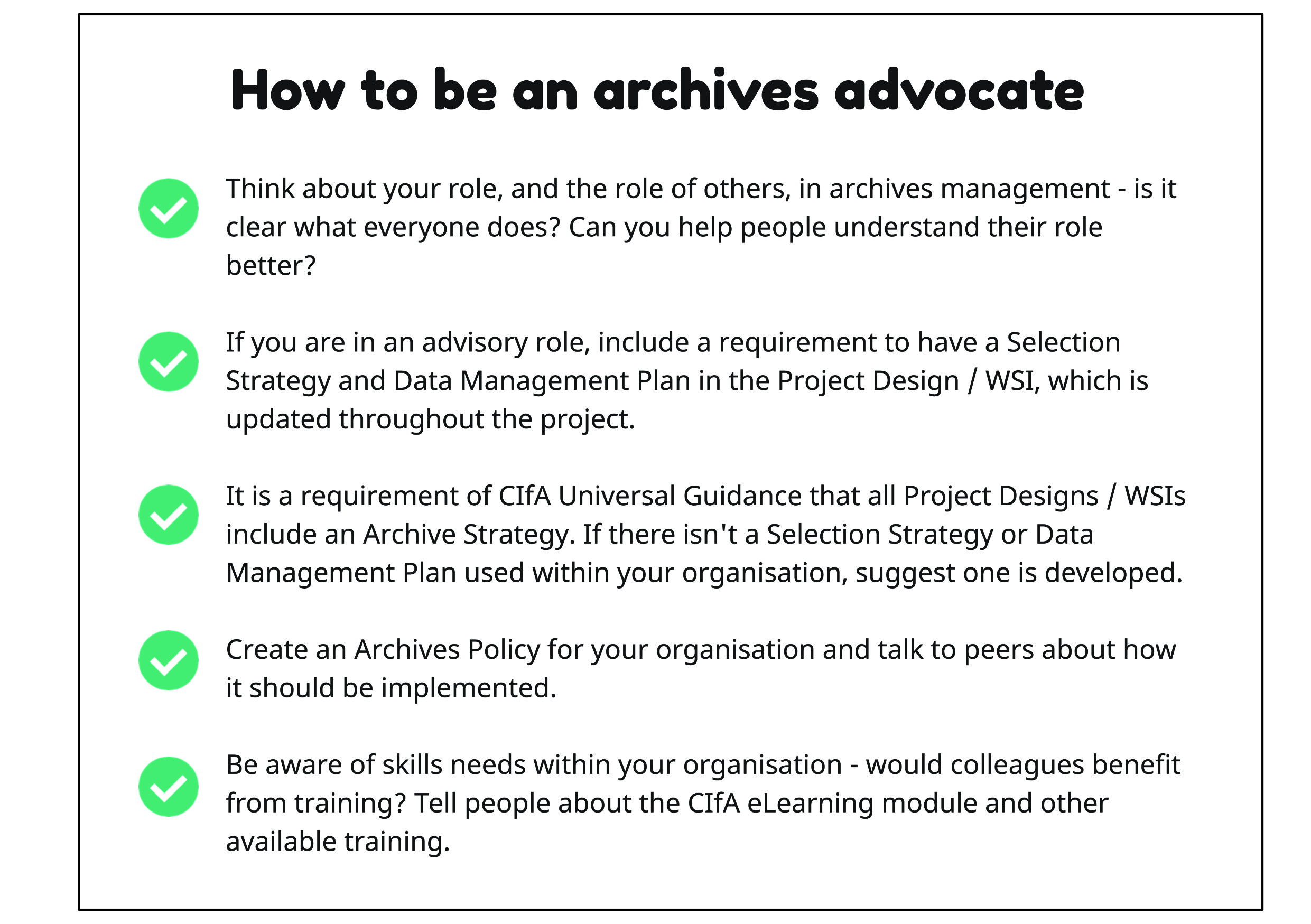
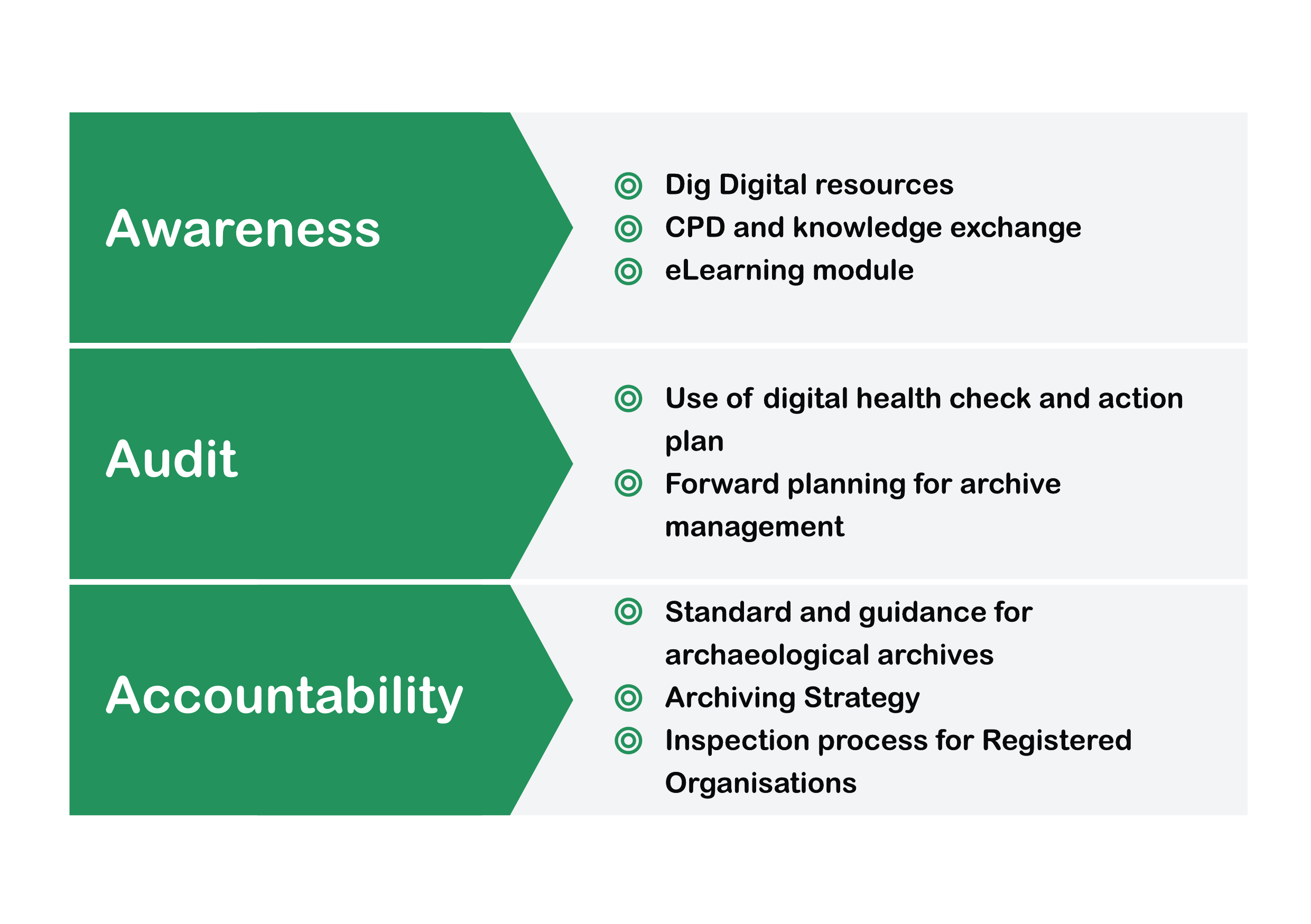
The Dig Digital project showcases the importance and value of collaboration, addressing significant challenges identified across the sector by supporting and embedding change in archaeological project delivery. In this case it was achieved via vital funding and support from Historic England and through working with members of the AAF to create an approach built around an existing framework of ethical practice. This focused on providing resources to support knowledge exchange and awareness, tools to identify and plan how best to approach digital data management and a framework to support ongoing good practice, accountability and enforcement (Figure 8). This integrated approach supports greater sustainability of the resources and helps to cement the changes in approach and practice required to facilitate change. Dig Digital's overall legacy is in emphasising the importance of being an archives advocate, which focuses on working ethically to recognised standards and guidance, planning for archives from the outset of projects and applying FAIR Guiding Principles.
The core of the Dig Digital project was a need identified by the sector and addressed collaboratively through the provision of guidance and resources to support improved and sustainable practice. Dig Digital aimed to transform archaeological data management by implementing sector-wide standards and guidance that ensure digital information is FAIR. Through collaborative stakeholder engagement, professional training and innovative tools, archaeologists can now better manage digital assets throughout project lifecycles, building individual practitioner capacity, and ensuring archaeological data remains secure, maintained and accessible to both specialist and public audiences for generations to come.
CIfA is the leading professional body representing archaeologists working in both the UK and overseas, promoting high professional standards and strong ethics in archaeological practice to maximise the benefits that archaeologists bring to society. To find out more see https://www.archaeologists.net/
Dr Manda Forster is an independent heritage consultant specialising in sustainable and inclusive heritage practice. As an active researcher and consultant, she delivers projects that celebrate people and places, ensuring heritage remains accessible, impactful and future-focused.
The Dig Digital project was delivered whilst Manda was Chief Operating Officer with DigVentures, a social business and platform enabling civic participation with archaeology, ecology and nature recovery projects. As well as increasing opportunities for real people to take part in real research, DigVentures designs practical and friendly training for heritage practitioners at all levels and is where you will find the Dig Digital online course.
Dr Jen Parker Wooding, MCIfA, is Head of Professional Standards at CIfA. Jen's role focuses on the management, review and implementation of the Institute's professional practice initiatives and standards. This includes managing projects and collaborating with sector colleagues/specialists to support the development and delivery of good practice guidance.
The Dig Digital project has benefited from the support of many. These include the Archaeological Archives Forum (AAF); Historic England and their team (Claire Tsang, Duncan Brown and Dan Miles); the Chartered Institute for Archaeologists (CIfA) (Jen Parker Wooding and Kate Geary) and the CIfA Archives Special Interest Group (Sam Paul); the Federation of Archaeological Managers and Employers (FAME) representatives (Helen Parslow); and the Archaeology Data Service (ADS) team (Katie Green and Nicky Garland). Thank you to all those who responded to consultation surveys, took part in workshops, and, most recently, the pilot group for the online course development. Dig Digital was delivered by Dr Manda Forster and colleagues at DigVentures.
Internet Archaeology is an open access journal based in the Department of Archaeology, University of York. Except where otherwise noted, content from this work may be used under the terms of the Creative Commons Attribution 3.0 (CC BY) Unported licence, which permits unrestricted use, distribution, and reproduction in any medium, provided that attribution to the author(s), the title of the work, the Internet Archaeology journal and the relevant URL/DOI are given.
Terms and Conditions | Legal Statements | Privacy Policy | Cookies Policy | Citing Internet Archaeology
Internet Archaeology content is preserved for the long term with the Archaeology Data Service (ROR). Help sustain and support open access publication by donating to our Open Access Archaeology Fund.
 Home
Home