Cite this as: Wright, H. and Richards, J.D. 2024 'Internet Archaeology: SEADDA Collection', Internet Archaeology. https://doi.org/10.11141/ia.seadda.1
The COST Action Saving European Archaeology from a Digital Dark Age (SEADDA) ran from 2019 to 2023, and while the Action undertook a wide range of activities, one of the primary outputs was a comprehensive set of publications in Internet Archaeology, published over the life of the project. Internet Archaeology was chosen for these outputs for a variety of reasons, including the opportunity to create this collection at the end of the project, bringing together publications released over several years and over several issues into one place.
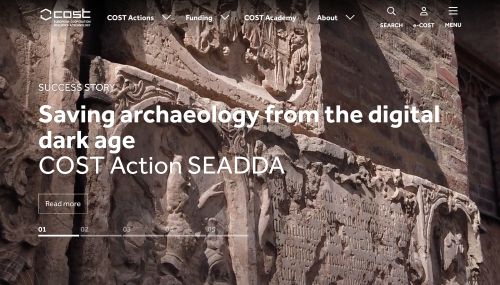
COST homepage screenshot with a news story highlighting the SEADDA project.
It is hoped that bringing the publications together in a cohesive way will act as both a record of the breadth of the work undertaken by the members of the Action, and create a lasting resource for archaeology, documenting our current situation. This includes the long-term care of digital archaeological resources, the collaborative work to improve these conditions and define best practice, along with future aspirations and work in creating foundations for this progress. The creation of this Collection after the completion of SEADDA was made possible by follow-on funding from the COST Innovators Grant (CIG): Sharing Archaeological Data Effectively (SHADE). The members of the COST Action SEADDA and the SHADE CIG would like to express their gratitude to the COST Association for their guidance and support, without which this important work would not have been possible.
The SEADDA Collection is divided into two sections: Syntheses and State-of-the-Art. The Syntheses section includes collaborative publications looking at an overall issue facing the preservation and open dissemination of digital data in archaeology, in some cases in collaboration with other initiatives such as the ARIADNE RI and the European Archaeological Council. The State-of-the-Art Publications are reflections on the current state of stewardship for digital archaeological data in a specific nation, country or region, written from an internal perspective. Taken together, these publications create a baseline understanding of where we have been, where we are, and where we must go if we are to both preserve and create better access to our archaeological data as we move forward, across Europe and beyond. The many authors below, and all the members of SEADDA and SHADE who contributed to this work, hope it is a useful resource and will support future progress.
Guntram Geser, Julian D. Richards, Flavia Massara and Holly Wright
This article presents the results of a survey of data management policies and practices of digital archaeological repositories in Europe and beyond. The survey was carried out in 2021 under the auspices of the European project ARIADNEplus and the COST Action SEADDA. Its main purpose was to collect and analyse information about current policies that determine access to and reuse of data held by digital archaeological repositories, and to investigate the guidance and support needed to make these repositories and data FAIR (Findable, Accessible, Interoperable and Reusable).
These policies comprise the regulations of heritage and research authorities/agencies, councils and other institutions at different levels (European, national/regional, local) as well as the repository rules governing deposition, access to, and reuse of archaeological data. The repositories are operated both by heritage sector institutions and by the research and higher education sector.
The survey represents a bottom-up approach by focusing on the actual policies and practices of digital archaeological repositories, which may reflect higher level regulations. A reality check in this regard can enable heritage and research authorities, councils and other institutions to reinforce or put in place regulations that bring current repository policies and practices closer to the ideal of providing FAIR and open access data. The survey results show that there is room for improvement in this regard and some suggestions are made here for future initiatives.
David Novák, Agnieszka Oniszczuk and Barbara Gumbert
The digital transition in archaeology is often taken for granted, yet the process is far from complete. The topic of digital archiving has been addressed by both the EAC Working Group for Archaeological Archives and the SEADDA COST Action. These two entities joined forces to produce a special issue of Internet Archaeology, bringing together contributions on digital archiving practices from over two dozen countries. The articles were later analysed by EAC and SEADDA to compare the international situation. The results reveal both shared difficulties associated with the issue of documentary archives worldwide and examples of good practices that help to overcome these problems. A questionnaire survey was also carried out to complement the findings resulting from the interpretation of the published articles, with supporting data covering the whole European area in a balanced way. The survey allowed for the compilation of an overview of the situation in 27 countries (30 regions) of Europe. All respondents were experts involved in digital archiving and/or heritage data management in individual countries. Based on the collected information, the discrepancy between the value of archaeological data and its position within heritage management practice is already proving to be a major shortcoming.
There are imbalances in the level of attention – and the resulting level of protection – given to archives of (digital) archaeological documentation. If we want to find a way to improve the situation, it is necessary to initiate systemic changes, which should manifest themselves on a number of levels. However, these changes are conditional on a political decision that will give the whole process legitimacy, the necessary resources, a clear framework, and the required tools. It is needed to formulate general principles and co-create an environment, including a legislative one, in which archaeological archiving can be carried out in a sustainable and meaningful way in order to bring the highest possible public benefit. Compared with other initiatives, we consider it essential to primarily follow the systemic changes (top-down approach) rather than strive for change in the individual practice of researchers. It is the only way to achieve the real persistence of irreplaceable archaeological data. This article summarises the results achieved and presents proposed approaches to improve the situation in digital archaeological archiving. It concludes, among other things, by proposing a set of guiding principles for archiving primary archaeological data.
Kristy-Lee Seaton, Rimvydas Laužikas, Peter McKeague, Vera Moitinho de Almeida, Keith May and Holly Wright
Over the last decade, innovation has centred on making archaeological data more interoperable, increasing the discoverability of data through integrated cross-search and facilitating knowledge creation by combining data in new ways. An emerging research challenge for the next decade is optimising archaeological data for reuse and defining what constitutes good practice around reuse. Critical to this research is understanding the current state-of-the-art regarding both existing best practices and barriers to using and reusing archaeological data. This research aimed to understand how to optimise archives and interfaces to maximise the discovery, use and reuse of archaeological data and explore how archaeological archives can better respond to user needs.
The study was bound by (i) the reuse of digital archaeological archives; (ii) orientation to content usability and reusability; (iii) maintaining a user-orientated approach; (iv) collecting data from professionals in archaeology and heritage. The research group members adopted the quality-in-use conceptual approach for this study. Quality in use is 'the degree to which a product or system can be used by specific users to meet their needs to achieve specific goals with effectiveness, efficiency, satisfaction, and freedom from risk in specific contexts of use'. The research methodology is based on the SQuaRE (System and Software Quality Requirements and Evaluation) model, represented in the ISO/IEC 25000 standards series. In addition, the quality-in-use metric for investigation of reuse and barriers to reuse of archaeological data were adopted from the standardised measurement functions and methods of ISO/IEC 25022:2016. The result was a methodological model composed of 5 characteristics (Effectiveness, Efficiency, Satisfaction, Context coverage and Usability) with 14 measures (Task completeness, Objectives achievement, Task time, Cost-effectiveness, Overall satisfaction, Satisfaction with features, User trust in the system, data and paradata, User pleasure, Physical comfort, Context completeness, Flexible context of use and User guidance completeness). The methodology was tested with specific Contexts of use (use cases), orientated to a distinct user with the specific professional goal of data reuse. Three use cases relating to 3D Pottery, radiocarbon, and GIS data were created. The pilot study has proven that the methodology works and could be applied in future research. This article discusses the application of the quality-in-use approach for evaluating the quality of digital archaeological archives, as well as presenting the methodology and the results of the pilot study.
Nurdan Atalan Çayırezmez, Deniz Çit and Holly Wright
The Saving European Archaeology from Digital Dark Age (SEADDA) COST Action (CA18128) is funded by the Horizon 2020 Framework Programme of the European Union and aims to create a network for archaeologists and digital specialists to build capacity for the long-term preservation of digital data for archaeology. More than 20 countries are involved in SEADDA, and have undertaken surveys, publications, workshops, STSMs (Short Term Scientific Missions) and other activities carried out to increase awareness and share expertise. Within the scope of the project, Internet Archeology 58 2021, titled "Digital Archiving in Archeology: Assessing the State of the Art", and then Internet Archeology 63 2023, titled "Digital Archiving in Archeology: Additional State of the Art and Further Analyzes" were published.
This article will give a brief introduction to SEADDA but will focus primarily on what we are learning from Internet Archaeology 58 and Internet Archaeology 63, how it is helping us to understand digital archaeological data around the world. In this study, 37 articles from 31 different countries were examined, according to three main categories: administrative structure, physical and digital archives for archaeological data. In the light of the data obtained, it is difficult to generalize about archaeological data processes and management; however, different countries and regions are applying different methods to create repositories. Legislation, budgets, and human resources are all factors which affect these processes for preserving digital archaeological data for future generations. But, all countries need to share expertise, and engage in capacity building, especially around legislations, human resources, standards and guidelines, whilst financial support needs to be prioritized.
This article/publication is based upon work from COST Action SEADDA, supported by COST (European Cooperation in Science and Technology).
Martina Trognitz, Sveta Matskevich, Réka Péter, Alexandra Szabó, Marton Gál, Vera Moitinho de Almeida & Sabina Batlle Baró
The planned publication shall provide an understanding of the concepts and principles of digital long-term preservation (or archiving) of research data. On one hand, it shall serve as a manual for researchers who don't have access to a trusted or certified digital repository and will provide information on the measures to take for preserving and sustainably disseminating research data. On the other hand, the publication will provide an overview of the technical requirements for the implementation of a service for the long-term preservation of data, as well as non-technical necessities like workflows and policies. The need for archiving will be contextualised by presenting the driving principles of good scientific practice.
This article/publication is based upon work from COST Action SEADDA, supported by COST (European Cooperation in Science and Technology).
Tim Evans, Hella Hollander, Valentijn Gilissen, Ulf Jakobsson & Holly Wright
The paper describes and compares key policies and workflows from three long standing digital repositories for archaeological data: DANS (Archaeology Data Station) from the Netherlands, SND from Sweden, and the Archaeology Data Service from the UK. The workflows examined are representative of operational workflows around data assessment and data removal that are common to all data repositories, as well as specific strategies of dealing with Microsoft Access Databases, a commonly deposited file format used by archaeologists for assessment and analysis. The paper will present each workflow as a succinct case study with an emphasis on why the decisions have been made to follow a certain method. This will be followed by a discussion on similarities and differences in approach and implementation so as to bring together core recommendations that can be used by others currently building or scoping the development of new digital repositories in the archaeological sector. The paper will link out to copies of the detailed workflows and policies to be deposited within COPTR, a finding aid for helping find tools to deal with practical data management issues.
This article/publication is based upon work from COST Action SEADDA, supported by COST (European Cooperation in Science and Technology).
Holly Wright, Julian Richards, Marija Šegan-Radonjić, Milica Tapavicki Ilic, Natália Botica, Amala Marx, Kai Salas Rossenbach, Nurdan Atalan Çayırezmez, Dragan Ivanovic, Marius Streinu, Anthony Corns, Espen Uleberg, Martina Trognitz, Hella Hollander, Keith May, William Kilbride, Edeltraud Aspöck, Sabina Batlle Baró, KL Seaton and David Novák
The Saving Archaeology from the Digital Dark Age (SEADDA) COST Action ran from 2019 to 2023 and produced a wide range of publications, opportunities for capacity building and knowledge transfer. This paper will discuss the less tangible forms of impact resulting from the work of the SEADDA members working within and across their own networks. These impacts include the new avenues of communication and collaboration created through the data stewardship and management focussed National Workshops held in Norway, Serbia, Portugal, Turkey, France, Romania and Ireland. Each workshop took a different form to be suit the needs of their community, but all resulted in progress towards ensuring the long-term persistence of digital archaeological data. This paper will describe the impact of each of these National Workshops.
SEADDA made and strengthened connections across a range of different areas of collaboration, primarily through work with members of the European Archaeological Council, the Digital Preservation Coalition, and the ARIADNE Infrastructure for archaeological data. Each of these connections has resulted in closer ties, ongoing collaboration and other forms of impact that would not have been possible without SEADDA. SEADDA was also committed to ensuring participation of non-EU countries which participate in the COST, and supporting doctoral students and early career researchers, and the impacts of these commitments will also be highlighted in this paper.
This article/publication is based upon work from COST Action SEADDA, supported by COST (European Cooperation in Science and Technology).
Map showing geographical distrbution of contributions
Julian D. Richards, Ulf Jakobsson, David Novák, Benjamin Štular and Holly Wright
The advent of ubiquitous computing has created a golden age for archaeological researchers and participating publics, but the price is a digital resource that is now in jeopardy. The archaeological record, in digital form, is at risk not simply from obsolescence and media failure, but the domain is also unable to fully participate in Open Data. Without swift and informed consensus and intervention, archaeology will lose the majority of its research data legacy capacity to a digital Dark Age.
Andrés D. Izeta and Roxana Cattáneo
This article discusses the state-of-the art of digital archives for archaeological research in Argentina. It also presents and characterises the national and international legal framework and the role played by funding agencies and professional bodies in archaeological practice. In addition, it reports how legal corpora regulate the impact on the management of archaeological digital data. Research infrastructures available at the national level are described, such as the Suquía, an institutional digital archive devoted to archaeology since 2016. Finally, we make a general evaluation of the status quo of research infrastructures mostly concerned with preserving and disseminating data from archaeological research at the national level.
Martina Trognitz
In Austria, archaeological research and excavation practice is shaped by a legislative framework and institutional actors. Besides the institutions, the role of private archaeological contractors has grown in the last decade and recently non-commercial associations have been founded. According to the Austrian Monument Protection Act, the Federal Monuments Authority issues permits for any archaeological excavation or survey activity. Documentation and preservation of physical material are regulated by the Monument Protection Act as well as by dedicated guidelines published by the Federal Monuments Authority. With the recent increased use of digital methods, the importance of preserving and disseminating digital data has risen. Although the Austrian government pursues a digitisation agenda including the promotion of Open Science, the availability of repositories suitable for long-term preservation of digital data does not meet the requirements arising from the ever-increasing amount of data.
David Bibby
Since 2005, the Landesamt für Denkmalpflege Baden-Württemberg has been collecting semi-structured archaeological digital project data with the aim of one day turning that data into a real long-term digital archive. This process is still ongoing. In the last 15 years appropriate data formats have been defined, and the transition from CAD to GIS as the mainstay of project recording in Baden-Württemberg has been made. The research-driven development of the Software Survey2GIS (GNU GPL), initiated by the Landesamt für Denkmalpflege Baden-Württemberg, facilitates on the one hand an easy-to-use transition of field data into GIS and on the other better control of data formats. We are learning to cope with increasingly more complex data - laser scan, LIDAR and sfm data. The recent advent of commercial archaeology in the state of Baden Württemberg is another factor with which we are confronted. We have experimented with the best methods of convincing archaeologists, technicians and ancillary staff of the necessity of saving their data in a central repository - for example friendliness, even occasional coercion, as well as the guarantee of recoverable data if the deposition rules are followed. The boundary of each saved excavation or survey project is uploaded to the State's own cultural heritage GIS-Application - ADAB - where it can be accessed by researchers. A simple click within the polygon will invoke metadata about the project as well as a selection of quintessential photos. The excavation archive in Baden-Württemberg is, as yet, by no means a fully accessible, usable 'real' digital archive. But we are succeeding in saving the data in a structured manner for future transition into that 'real' archive - hopefully as a pilot project within the framework of the federally financed NFDI infrastructure.
Silke Jantos and C. Sebastian Sommer
Over the last two decades, technical progress for archaeology within the Bavarian State Department of Monuments and Sites (BLfD) underwent rapid development. It began with the establishment of an information system (FIS) where the workflow of the Department of Archaeological Heritage is mapped. The next step consisted of standardisation of data capture for all institutions and companies undertaking excavation. In response, a homogeneous data model was developed and established through the application ExcaBook. In order to guarantee this solution would be used widely, an Importer was created to import data from other databases or applications. Hereafter it is also planned to process data from restoration and conservation projects, using a similar approach in order to work towards improving data exchange between all related sciences.
David Novák, Martin Kuna and Olga Lečbychová
As in other countries, Czech archaeology has embarked on a journey of digitisation. This creates the need to cope with the rapid growth of digital data, which must be stored securely over the long term and be accessible in a comprehensible and useful way. This causes several problems. Although there is a centralised and well-resourced digital agenda that meets the requirements of the Heritage Law, outdated legislation and the absence of comprehensive rules do nothing to regulate the management of the most valuable data - the primary documentation of fieldwork events. At present, only summary information on archaeological fieldwork and the final reports, which should contain a substantial selection of documentation, are centrally collected and stored. This is a situation that is difficult to accept as primary (raw) data with a greater information value is disappearing into thin air. The premise for change lies in supplying the existing central infrastructure - The Archaeological Information System of the Czech Republic (AIS CR) - with the tools to acquire and archive primary data on a larger scale, while at the same time, amending the legal obligations imposed on archaeological practitioners. Sustainable change requires a significant overhaul of the current concept, objectives and especially the practice of archaeological fieldwork projects, particularly in the planning and post-excavation phases.
Claire Tsang
Across Europe, countries are at different stages of dealing with digital archaeological archives and how those archives are dealt with is affected by differences in statutory requirements, legal ownership of archives and infrastructure. In England, there is no single national repository for archaeological archives and there is no legal requirement to deposit either physical or digital archives with public bodies, and deposition rates for digital remain low. The archaeological sector remains aware of the implications of producing ever-growing quantities of born-digital data, which interested parties are attempting to address. The current framework and situation regarding digital archiving in England, therefore, offers an interesting case study for how digital archiving is dealt with through the application of professional standards, rather than legislative requirements.
This article aims to summarise the current situation regarding digital archaeological archives in England. Across the UK there has been a great deal of work and focus on archaeological archives, driven by two main factors: archaeological archives are curated by a network of regional and local museums and currently resources are shrinking in terms of storage capacity and archaeological curators. Repositories for physical archives can therefore be ill-prepared for the curation of digital archaeological archives, which can risk loss of archaeological digital data, and in 2017 this was recognised within the UK government's Mendoza Review (Mendoza 2017). This article describes the current work to resolve these issues - including strengthening the planning process, providing standards and guidance for data creators and repositories.
Piraye Hacıgüzeller, Koen Van Daele, Frank Carpentier and Raf Ribbens
This article provides an overview of the current state of archaeological digital archiving in Flanders (Belgium). It briefly outlines the legally defined stakeholders and actors through which archaeological fieldwork is regulated and carried out. It subsequently describes related digital documentation and archiving practices, and guidelines. This is followed by a discussion on compliance with the FAIR Guiding Principles, and the article concludes with notes on the past and future of archaeological digital archiving in Flanders.
Despoina Tsiafaki and Markos Katsianis
This article provides an overview of the current situation in Greece regarding digital archaeological data stewardship. A brief chronicle of Greek archaeology sets the scene for a better understanding of the present situation. Greek archaeology is supervised by the Ministry of Culture and Sports, with the Archaeological Service as the central organisation in charge of antiquities. However, archaeological data resulting from archaeological fieldwork are produced by several other entities. This article presents the policies governing both physical and digital documentation archives. It introduces the current practices for archaeological data preservation and the relevant digital infrastructures, attempting to showcase the existing environment. We categorise prevailing problems on three levels, all based on the fact that digital and open access arrived recently in a well-established environment formed gradually over almost two centuries.
Even so, fragmentation and variation would be the proper terms to describe the status of the stewardship of digital archaeological data in Greece. Our review shows that there is substantial effort directed towards digital archaeological data stewardship and accessibility by all stakeholders within the archaeological sector. Finally, we add a few thoughts and suggestions, and indicate the need to generate a network that could take steps towards more inclusive strategies within digital data stewardship. The key to leveraging change is raising awareness about data sustainability and reuse, and the COVID-19 outbreak indicates a clear change in mentality in this direction, since open access resources have begun to be key to education and research conducted in Greece.
Attila Kreiter
In Hungary, certain site documents, such as the Preliminary Archaeological Documentation (PAD), 30-day report and 1-year report, have to be submitted to centralised institutions. The content and format of these documents are regulated, facilitating their digital archiving and accessibility. However, further documents (inventories, databases, scientific assessments, interdisciplinary analysis, photos, drawings, etc.), mainly created by the museum that carried out the excavation, may not end up in the designated repositories. Instead, these documents are stored in the local museums that carried out the excavations and/or where the finds are kept.
It is a major problem that there is no officially-appointed, centralised hard copy and/or digital repository in Hungary where all site documents are stored and made accessible. In this respect, there are millions of files stored in museums all over the country that are neither used nor reused and are not accessible, and without the archaeological community, or even central institutions, being aware of them. Another problem is that digital archiving of archaeological documents is not regulated either on a national or local level.
The only repository that includes both metadata and documents in Hungary is the Archaeology Database of the National Museum. This database provides a solution for depositing digital documents, and it could serve as a national repository where documents can be stored and accessed online in one place (through access levels). However, submitting digital documents to the archaeology database is unregulated and it is completely voluntary. The archaeology database has the potential to assist archiving on a national level should it become compulsory to submit documents to it, as its structure was designed in accordance with the protocols and it hosts documents.
Sveta Matskevich and Liat Weinblum
In this article, the authors present two points of view on the preservation and dissemination of archaeological data in Israel: an official version of the policy makers (the Israel Antiquities Authority, henceforth IAA), and the view from the archaeological, especially academic, community outside the IAA. This includes an assessment of the strategies undertaken (or not) over the last 40+ years resulting in t he majority of data being inaccessible, and documenting significant data loss since the 1990s. This is followed by current work to address these issues, including not only efforts to digitise but misconceptions about the problems digitisation both solves and creates, along with recommendations for how to approach the issues going forward.
Yuichi Takata and Peter Yanase
Japan is producing a vast amount of archaeological data because of the high number of rescue excavations taking place every year in the country. However, municipal administrations are struggling to cope with storing and disseminating the accumulated data. This article gives an overview of how fieldwork reports and archaeological illustrations are framed in national policies and how that affects the way they are handled locally, both in physical and digital form.
Agnieszka Oniszczuk and Agnieszka Makowska
Archaeology in Poland, as in any other corner of the world, thrives on the application of digital technologies in fieldwork and subsequent analysis. Unfortunately, legal and administrative solutions have not been responsive enough to keep up with these changes.
This article summarises the reality of archaeological digital archiving in Poland, shaped by a legally determined focus on paper documentation and the decentralisation of the state heritage service. The practice of digital archaeological archiving is illustrated by the results of a survey carried out among archaeologists from provincial heritage offices. It has revealed that, while they struggle with a lack of adequate technical measures and skills, they also opt for increasing the significance and proportion of digital archaeological archives and realise what should be done for this Digital Dark Age to end.
On a more general level, the existence of digital documentation has already been recognised in laws on archiving and implementation of IT solutions. This article describes the actions taken at a national level to tackle these issues; namely, two state repositories: one for electronic documents and the other for digital resources of science and culture. It also presents current initiatives of the National Institute of Cultural Heritage in this regard.
Natália Botica
Archaeology produces large quantities of data, much of it already in a born-digital format. The preservation of these data is vital, as they result from unrepeatable actions, and access to and sharing of these data are the engine of research activities and knowledge development. The creation of archaeological data repositories, in addition to safeguarding data, is a valuable step in supporting research, but it requires a series of work processes, namely data standardisation and use of common nomenclatures, so published data are findable and reusable.
The creation of an archaeological data repository for Portugal is a fundamental requirement. It would allow the safeguarding of data resulting from archaeological fieldwork, along with those resulting from research, making them findable, accessible and liable to be used in future research or even to be re-analysed using new technologies and tools. This article presents the evolution of the digitisation of archaeological information in Portugal, the responsibilities for its production and safeguarding, as well as the steps to be followed for its availability in a data repository.
Peter McKeague
Hosted by Historic Environment Scotland (HES), the National Record of the Historic Environment (NRHE) is the primary place of deposit for archaeological archives in Scotland. Built up over several decades, the archives hold over 1.6m items, both analogue and digital, linked to a site inventory of over 320,000 site records relating to the archaeological and architectural history of Scotland. Initially the survey archive of the former Royal Commission on the Ancient and Historical Monuments of Scotland, the collections now include project archives from professional archaeological companies, academic researchers and, increasingly, community projects. A range of policy and professional drivers, as well as best practice, encourage archival deposition. The digital component of the archive has grown considerably over the last decade. In response, the NRHE has invested in preservation software to manage these holdings and has submitted an application for CoreTrustSeal. The NRHE is available online through the Canmore database and web-map applications. The online presence is assessed against the FAIR Data principles.
Marija Šegan-Radonjić and Milica Tapavički-Ilić
In the Republic of Serbia, digitisation of cultural heritage was recognised as a segment of cultural development, while the digitisation process is understood as part of a complex system of managing cultural heritage in institutions of protection, such as museums, institutes for the protection of cultural heritage etc. By focusing on the issue of electronic/digital archaeological heritage management in Serbia's institutes for protection, this article briefly describes the national framework of archaeology in the country and presents some crucial moments in the journey towards digitisation and electronic management of archaeological heritage in Serbia since the 1990s. It also discusses recent efforts by the Ministry of Culture and Information in terms of regulating the procedure of cultural heritage digitisation and establishing a common information system. Finally, it identifies current challenges in archaeological data management in cultural heritage institutions and briefly discusses possible future scenarios.
Peter Bisták, Ján Zachar, Alexandra Rášová, Tibor Lieskovský, Ivica Kravjanská, Martina Orosová, Kristína Kročková and Michal Felcan
The Monuments Board of the Slovak Republic (MB SR) and the Regional Monuments Boards have been the state administrators of the cultural heritage, including archaeology, since 2002. This article aims to map the current state of archaeological digital archives within MB SR and eight Regional Monuments Boards, as well as present the usage and management of digital datasets within ongoing projects. The central archive of the MB SR maintains historical plans and cultural heritage documentation, created since the 1920s and continuously digitised (the collections of negatives, diapositives, projects, plans, schematic maps, and fieldwork documentation). Since 2012, MB SR has taken part in the Digital Monuments Fund project. Within this project, 2D and 3D documentation of a great number of cultural monuments has been created. In 2019 the implementation phase of the Monuments information system (PAMIS) project started. Its basic modules are the presentation layer, the knowledge agenda and state administration. There are several features in preparation within these modules, such as: updating; collection, consolidation and GIS processing of archaeological site data that belong to the monuments fund, including data from aerial laser scanning; the archaeological excavation registry and the archive of fieldwork reports; the registry of finds in the administration of MB SR; the electronic processing of the state administration activity within the protection of the archaeological cultural heritage. The PAMIS project will provide processed data and make them accessible to the state and public administration, owners of monuments, as well as to professionals and the general public, using online solutions (web GIS) with various approaches according to defined user roles.
Benjamin Štular
This article presents the archiving of archaeological digital datasets in Slovenia in its historic context. The datasets discussed have been separated into three categories: non-reproducible datasets, reproducible datasets, and registries. Several reproducible datasets created by ZRC SAZU have been freely available online since the early 2000s, but the number of users is small and those benefiting often do not adhere to clearly stated copyright limitations. There is a large discrepancy between the stated interest and the actual usage of reproducible, let alone non-reproducible, online datasets disseminated as open access. In addition, adherence to fair use cannot be expected unless enforced. The key outcome of this study is that it has exposed a total absence of systemic archiving practice for non-reproducible digital datasets. The article concludes with recommendations and next steps that could be taken to address these issues in future. First and foremost, a systemic approach to digital archiving is urgently needed if the irreversible damage to the decades worth of born-digital non-reproducible digital data is to be averted.
Daniel Löwenborg, Maria Jonsson, Åsa Larsson and Johan Nordinge
Heritage management in Sweden has undergone a substantial transformation in recent decades. The process of monitoring and managing heritage information has become increasingly digital, relying on interconnected systems to monitor registered archaeological remains to manage investigations and contract archaeology excavations. This also has to work together with the digital systems of the County Administrative Boards that administer all permissions for excavations. Current developments deal with archiving and dissemination of reports, and documentation from fieldwork. Documentation of archaeological excavations has predominantly been digital for the past 20 years, which brings both possibilities and challenges in making sure the information will adhere to the FAIR Principles. This article outlines some of these developments and exemplifies the possibilities of reusing legacy data through the Urdar project.
Ulf Jakobsson
In the past, data from archaeological investigations, as well as research projects led by universities have not been archived or made publicly accessible. Synthetic publications such as papers, reports and articles have been available, but not the underlying data files containing the original data to be reused or combined with new/other datasets for further research.
Archaeological investigations are regulated within Sweden, but it has only recently been possible for that data to be preserved and disseminated in a more streamlined way. The mandatory requirement to archive research data at universities is often not enforced, resulting in a loss of data that is very problematic. This is now slowly changing owing to requirements from both governmental bodies and funding agencies, and therefore the future of archaeological data in Sweden looks a bit brighter.
Nurdan Atalan Çayırezmez, Piraye Hacıgüzeller and Tuna Kalayci
This article provides a brief overview of archaeological digital archiving in Turkey. It introduces the legal framework and the stakeholders involved in conducting archaeological excavations and surveys. The current situation in archiving born-digital and digitised documentation produced during archaeological fieldwork is then introduced. Existing repositories serving as hubs for archaeological and heritage archiving are listed and briefly discussed. Analysis of online publishing practices for archaeological digital resources points to an eclectic landscape that only minimally complies with the FAIR (Findable, Accessible, Interoperable, Reusable) principles. We conclude that guidelines for best practice in metadata and semantic technologies, locally applicable standards (especially controlled vocabularies), technical know-how, and a larger acceptance of open data and scholarship remain much-needed assets for archaeological digital archiving in Turkey. We also conclude that the future promises progress towards more interoperable archaeological digital archives thanks to international training, network and knowledge transfer opportunities (e.g. SEADDA Project).
Julian D. Richards
Owing to its early lead in the world of digital preservation, fostered by the creation of the Archaeology Data Service in 1996, the UK is often considered to be in an advanced position for digital archiving of archaeological data. In some ways it is, but the situation is also complex, due to a highly fragmented landscape, spread across four nations, and multiple sectors. This overview article describes the organisation and structure of archaeology across the UK, and the provision for digital preservation and access. Digital archiving is still far from standard, but the situation is improving, and rests on firm foundations.
Christopher Nicholson, Rachel Fernandez and Jessica Irwin
Archaeology in the United States is conducted by a number of different sorts of entities under a variety of legal mandates that lack uniform standards for data archiving. The difficulty of accessing data from projects in which one was not directly involved indicates an apparent reluctance to archive raw data and supplemental information with digital repositories to be reused in the future. There is hope that additional legislation, guidelines from professional organisations, and educational efforts will change these practices.
Nadezhda Kecheva
This article provides an overview of the current state of archaeological archiving in Bulgaria. It briefly outlines the legislation that regulates archaeological fieldwork activities. Although the national legislation regulates the non-destructive and destructive activities equally, differences occur owing to the existence of the 'Archaeological Map of Bulgaria', a national 'sites and monuments' type of archaeological information system. Currently, online storage of brief data and information is possible for different archaeological sites. Its next version will be based on GIS and geographic features that allow storage of raw field survey data. According to the regulations, paper/digital reports of all fieldwork activities are collected yearly and copies of all of them are stored at the 'Scientific Archive' section at the National Archaeological Institute with Museum at the Bulgarian Academy of Sciences. Although their digitisation is still in the early stages, the good news is that the centralised archaeological workflow regulates their storage in one place, which makes them more easily accessible. The annual publication of the 'Archaeological Discoveries and Excavations' series, with summaries for all fieldwork activities in the year, is also very useful for keeping track of the archaeological work and results.
Sabina Batlle Baró
Archaeological data archiving has not been a major concern in Catalonia. The heritage legal corpus does not engage with the archiving and curation of archaeological data other than the excavation reports. However, it highlights the responsibility of the administration in cataloguing and disseminating the cultural heritage. For this reason, a lot of effort has been invested during the past few years in inventorying known archaeological sites and publishing archaeological reports, with the aim of increasing the transparency of the administration towards its citizens.
This article describes the present situation for archaeology in Catalonia, its legal framework and the main initiatives carried out to archive, manage, and publish archaeological data from a user's point of view. Its main aim is to evaluate the current state of archaeological data archives and public databases by analysing the existing platforms with a set of indicators. This assessment leads to the conclusion that the current repositories and databases could be more worthwhile if some limitations were overcome, but also that the advance in archaeological data archiving is restricted by existing law.
Amala Marx, Kai Salas Rossenbach and Emmanuelle Bryas
In France, the archaeological sector has undergone a major shift in the last 10 years in terms of digital data creation and management. The digital transformation of the profession and its practices is still in progress and is not uniform. If general policies and laws are now clearly adopted at a national level, then institutional or individual situations are more complex. We can clearly separate the development-led and academic sectors, with reference to the volume of data produced and the challenges faced. A critical overview of the barriers highlights the fact that, beyond technical issues, data management (specifically sharing) is a human challenge in terms of scientific priority and in the adoption of new practices. This article gives an overview of the main questions and issues with reference to major nationwide initiatives.
Elena Calandra, Valeria Boi, Annalisa Falcone, Valeria Acconcia, Sara Di Giorgio, Flavia Massara and Paola Ronzino
This article highlights how the Italian Central Institute for Archaeology (ICA) is developing the National Geoportal for Archaeology (GNA), based on the ARIADNEplus infrastructure and its policy framework. Thanks to the GNA project, it will be possible to search and learn about archaeological documentation managed by Superintendencies and Universities holding a significant amount of archaeological data, much of which is either completely or partially unpublished.
Hella Hollander
Digital archaeology in the Netherlands is connected with investments in a new large-scale and innovative Dutch research infrastructure for the next 10 years. Priorities are set to combine forces at a national level in order to contribute to the international position of the Netherlands as a 'knowledge country'. Researchers need to coordinate and collaborate even more to set up a FAIR enabling data infrastructure with limited resources. Regarding the archaeological discipline, the use of formal quality standards and legislation that certifies archaeological organisations to carry out archaeological work improves national collaboration and stimulates the digital workflow. DANS is the dedicated national repository for archaeology in the Netherlands and is launching the Data Station Archaeology, a repository meeting the latest technological standards. Finding and sharing data of high quality facilitates knowledge of archaeological discoveries; a flourishing open access trend in Dutch archaeology stimulates a strong growth in the use of data. To keep up with innovative developments, a growing community of archaeologists and other specialists are working together in international projects to secure the future of European Archaeology.
Mieko Matsumoto and Espen Uleberg
Archaeological documentation from surveys and excavations in Norway are created by a limited number of actors. Excavations are mainly carried out by the five university museums. NIKU (Norwegian Institute for Cultural Research) is responsible for excavations of medieval cities and churches. Maritime museums excavate in lakes, rivers, and below past and present sea level. Archaeological surveys are mainly the responsibility of the counties.
Riksantikvaren (Directorate of National Heritage) is responsible for the national Historic Environment Records (HER), Askeladden, which offers the possibility to upload or insert links to reports from archaeological investigations. Riksantikvaren also archives excavation documentation from churches and medieval cities. The Norwegian university museums have, since the 1990s, cooperated on digitising a national repository and making the collections available online. Presently there are also repositories at the maritime museums, Riksantikvaren and the counties. The infrastructure ADED (Archaeological Digital Excavation Documentation) is a repository for detailed excavation documentation, and the BItFROST infrastructure project contributes to better storage and availability of 3D data. Future development will be more complete national databases, and towards closer international cooperation, creating better integration and availability of several repositories.
Filomena Sirovica and Ivan Radman-Livaja
Dealing with various aspects of archaeological research typically results in diverse and often very large datasets and, over the last few decades, primarily in a born-digital format. These data may be produced in many ways, but when we refer to archaeological data, we typically mean the primary data collected during various forms of archaeological fieldwork. Such data represent the primary information about fieldwork procedures and original archaeological contexts, while in the case of archaeological excavation, it serves as the sole remaining evidence of the contextual significance of archaeological features and finds. Therefore, it holds immense importance for archaeological heritage, and undoubtedly, the procedures for data archiving become the most vital prerequisite for its long-term preservation.
In Croatia, the legal framework for managing cultural heritage is defined by the Act on the Protection and Preservation of Cultural Objects. Simultaneously, archaeological activities are governed by the Ordinance on Archaeological Research, which, together with the Act on Museums, also regulates the archiving of field documentation. These regulations stipulate that, in addition to archaeological finds, fieldwork documentation must be submitted to a competent public museum institution. Consequently, museums bear legal responsibility for the archaeological documentation and its archiving. While Croatian museums have established long-standing and standardising procedures for collecting data on museum objects, no standards or guidelines have ever been established for archiving datasets created during archaeological fieldwork. Given the absence of a national digital data archiving system for archaeology, this article focuses on considering the factors necessary to establish an appropriate infrastructure for digital data archiving in Croatia.
Marius Streinu and Bogdan Șandric
The aim of this article is to put into perspective the efforts of more than 150 years of attempts to create archaeological repertoires and archives at a national level in Romania that correspond to changing needs through time. Along with technological advances, centralisation and digital archiving have provided the prerequisites for the creation of a national archaeological repertoire that contains, as far as possible, all the information available for each individual site, and being associated with resources that can be found in other databases, making it a dynamic tool that is continuously updated. Other databases are featured as they make up the digital record of the archaeological heritage in Romania and provide content to the national archaeological repertory. Future plans regarding the improvement of all these databases are presented.
Meliha Handzic and Ivana Pandzic
This article provides a brief overview of the current state of digital archaeology in Bosnia and Herzegovina (BIH) and points to major challenges for its future. It presents the most important efforts and achievements made by institutions, communities and individuals involved in various digitisation projects. The article also reveals significant obstacles that limit the current scope and speed of the digitisation process. In order to move forward, the article advocates the adoption of a 'participative perspective', where different stakeholders may participate in a socially inclusive way to remember and celebrate BIH cultural heritage through digital archives, exhibitions and storytelling practices. The article also suggests the need to take a more holistic approach to managing BIH archaeological knowledge in a digital environment in order to realise the full power of that knowledge.
Anthony Corns, John O'Keeffe and Rónán Swan
The creation of a trusted digital archive in Ireland with the establishment of the Digital Repository of Ireland provides the opportunity to archive, manage and facilitate open access to archaeological and historic environment digital data. This overview explores the present situation in Ireland and describes the current responsibilities of several of the state bodies and organisations in Ireland and their response to providing open data. Examples are given within the geospatial domain, where more progress has been achieved, and the initiatives of Transport Infrastructure Ireland in opening up their resources are examined. Finally, with the advent of new government policy and potential legislation, future possibilities are highlighted.
Valentina Vassallo, Luciarita Nunziata, Maria Makri, Aspasia Soula Georgiadou and Sorin Hermon
This article presents the current state of the art regarding digital archiving for archaeology in Cyprus. The analysis of the current European situation shows that various countries have reached diverse levels of digitisation concerning archaeology and have different ways of dealing with digital archiving. These differences depend on several factors, such as the presence or lack of expertise, information regarding the procedure, and availability of funding, as well as the history of archaeology of the country. The current contribution analyses the Cypriot state of the art of digital archiving for archaeology in the broader context of the digital transformation era, which drives all major changes and strategies in various sectors of society at both national and international level. This article describes the archaeological background of Cyprus, its peculiarity and challenges and how these elements shape the digital management of the field. The article also presents the main actors involved in archival digitisation and the most relevant digital archaeological repositories, underlining innovative approaches and current gaps. Finally, it addresses the future directions of digital archiving for archaeology in Cyprus.
Reiner Göldner, David Bibby and Henriette Senst
Archiving of digital research data according to established standards and methods is an important part of the research data lifecycle. It guarantees the long-term transparency and reusability of research results. This is especially important in the case of archaeological data where the preservation of unique and irreplaceable cultural heritage is paramount. To gain insight into the current state of affairs regarding long-term archiving in Germany, the SEADDA (Saving European Archaeology from the Digital Dark Age) COST Action and the Commission on Archaeology and Information Systems in the Association of German State Archaeologists, with the support of the IANUS Research Data Center of the DAI, conducted a survey in spring/summer 2021. This article presents the results of the survey along with recommendations for further and supporting measures aimed at improving the long-term archiving of digital archaeological data in Germany.
Nadezhda Kecheva
This article provides an overview of the participation of the National Archaeological Institute with Museum at the Bulgarian Academy of Sciences (NAIM-BAS) as a partner in both the ARIADNE and ARIADNEplus projects and the SEADDA COST Action. The article examines both the workflow and the results obtained when modifying and mapping part of the national site and monuments information system, also known as the 'Archaeological Map of Bulgaria' (AIS AKB). The article's focus is mainly on the technical preparation of data shared through the ARIADNE portal. The main workflow followed throughout the projects included mapping terms to the Getty AAT thesaurus, adding Bulgarian archaeological chronologies to PeriodO, and mapping metadata to the ARIADNE catalogue data model (ACDM) in ARIADNE and to the AO-cat ontology in ARIADNEplus. In 2016, a mapping of AIS AKB to the CIDOC CRM was also undertaken, and the first steps towards creating the geographic information system, 'Archaeological Map of Bulgaria' (GIS AKB), were taken. The experience gathered by the NAIM-BAS team members throughout the whole project was important for moving towards FAIR-ness in Bulgarian archaeology.
This collection of publications is based upon work from the COST Innovators Grant SHADE IG18128 supported by COST (European Cooperation in Science and Technology). COST (European Cooperation in Science and Technology) is a funding agency for research and innovation networks. Its Actions help connect research initiatives across Europe and enable scientists to grow their ideas by sharing them with their peers. This boosts their research career and innovation.

Internet Archaeology is an open access journal based in the Department of Archaeology, University of York. Except where otherwise noted, content from this work may be used under the terms of the Creative Commons Attribution 3.0 (CC BY) Unported licence, which permits unrestricted use, distribution, and reproduction in any medium, provided that attribution to the author(s), the title of the work, the Internet Archaeology journal and the relevant URL/DOI are given.
Terms and Conditions | Legal Statements | Privacy Policy | Cookies Policy | Citing Internet Archaeology
Internet Archaeology content is preserved for the long term with the Archaeology Data Service (ROR). Help sustain and support open access publication by donating to our Open Access Archaeology Fund.
 Home
Home